

If you are curious about the Messer as a HEMA weapon or just starting out, I hope the information below is helpful. Feedback is welcome and appreciated in the comments.
My goal with this article is to share the sources that got me going as well as provide the Messer apprentice curriculum I have developed. I am happy to say that I am now teaching this weapon in our school using this information. My school can be found here if you are local and would like to check us out: http://noblescience.org/
The Messer
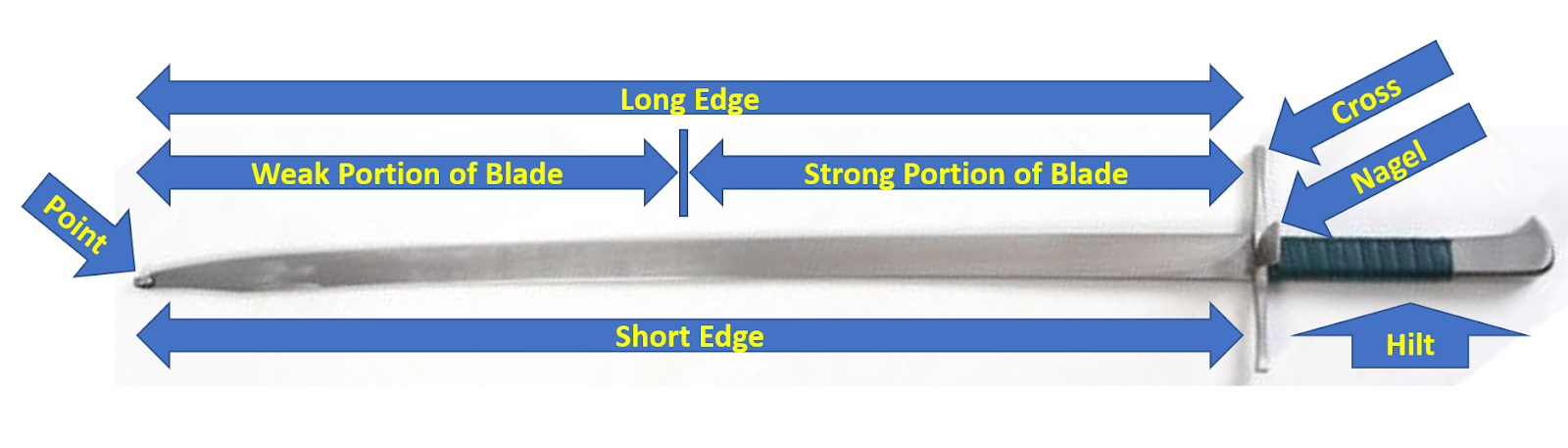
From Wikipedia – https://en.wikipedia.org/wiki/Messer_(weapon)
A messer (German for “knife“) is a single-edged sword with a knife-like hilt construction. While the various names are often used synonymously, messers are divided into two types:
Lange Messer (“long knives”) are one-handed swords used by the Bourgeoisie (middle-class civilians) for personal self-defense. They were about a meter long and may have evolved from the Bauernwehr(“peasant’s sidearm”). They are also known as Großes Messer (Great Knife).
Blade
Messers are characterized by their single-edged blades. The lengths and shapes of the blade can vary greatly. Messer blades can be straight or curved. Extant examples of langes messer seem to have an overall length of 30 inches (760 mm) with a 24.5 in (62 cm) blade, and a weight between 2–2.5 lb (0.91–1.13 kg).
Hilt
The defining characteristic of messer is their hilt construction. Quite notable in its construction was the attachment of the blade to the hilt via a slab tang sandwiched between two wooden grip plates that were pegged into place. Messer often include a straight cross-guard and a nagel: a nail-like protrusion that juts out from the right side of the cross-guard away from the flat of the blade, to protect the wielder’s sword hand. The lengths of hilts can range from one or two-handed grips.
Curriculum:
- Focus for Apprentice
- Movement
- Deflection
- Guards
- Protection (hands)
- Focus for Scholar
- 6 Master Strikes
- Closing and Controlling (grappling)
- Focus for Scholar Adept
- Disarms
- Messer and Buckler
Apprentice Material:
- Parts of the Messer – See picture at top of document
- Balanced Stance – Stand feet shoulder-width-apart, either foot forward. Knees bent, weight on balls of feet. Forward foot should be pointed at your opponent.
- Steps
- Passing Step – Step forward with one foot traversing in front of the other, usually done with the passing step slightly offline of the opponent in a diagonal direction on the side of the passing foot.
- Simple Step – Move the front foot forward in a line followed by the back foot. Slower, but maintains a wide base for balance
- False Step (Gathering Step) – Move the back foot up to the leading foot and then move the leading foot forward. Faster than a simple step and more deceptive, but when feet are together you are vulnerable to being knocked off balance.
- Triangle Step – Forward traversing step to the right with the right foot (moving you toward your opponent’s left flank), followed by a slight pivot of the left foot back-and-to-the-right
- Grips – Practice shifting between the various grips
- Hammer Grip – Hold the hilt of the messer in your fist.
- Handshake Grip – Thumb on the back of the hilt of the messer, point extended outward.
- Thumb Grip – Hammer grip shifted so that your thumb is up and on the flat of the blade, opposite the nagel.
- Protecting the Hand(s)
- One of the primary targets in Messer is the hand
- In all guards, keep your sword hand back and out of your opponent’s measure or safely behind your cross.
- Offhand should be kept either behind the back or close against your chest, ready to reach out and grapple.
- Langenort – “long point” – Guard – Hold the Messer out in front of you, point towards your opponent, arm fully extended

- Thrust – Simple thrust with true time. Sword moves, then arms, then body, then legs. It helps to imagine a string attached to the tip of the sword pulling you towards your target.
- Luginsland – “the watchtower” (Vom Tag) – Guard – Balanced stance with the messer held over the right or left shoulder. Can be in a thumb grip or a standard grip. The forward leg should be the opposite of the shoulder the messer is being held over.

- Oberhau – Descending strike, diagonal from right to left or left to right. Should end in a low guard or in a lower hanging guard with the messer in front of you with the point online with your opponent.
- Eber – “the boar” (Phlug) – Guard – Balanced stance with the messer held with the hilt near the right or left hip, tip forward. This guard is always held in a thumb grip. The forward leg should be the opposite of the hip the messer is held near. If the guard is on the opposite hip from the sword hand, the messer is held with the true edge up (or nearly up).

- Simple Parry from right Eber (also called Bogen in Lecküchner)
- Stand in Right Eber, left foot forward
- When struck from above, step forward in a passing step and parry above, true edge up
- Cut around while finishing a triangle step – target head or arm depending on measure
- Simple Parry from left Eber (also called Bogen in Lecküchner)
- Same as above, but reverse (point should be to right side)
- Due to geometry of the footwork, the head should be an easy target on this side
- Messer Taking
- Perform an oberhau
- If your opponent blocks with a simple parry (as above) and the handle of their messer is on the same side as your off hand, step forward and grasp the handle of their messer with your hand, thumb toward their hand.
- Wrench their messer out of their hand
- Unterhau – Rising strike. This can be either from your side or a wrist cut in front of you depending on the situation and measure. Should end in a hanging guard with point online to your opponent.
- Nagel Parry
- When struck from above, parry with the hand inverted so that the true edge points up in an einhorn-like stance. The opponent’s blade should end up striking the flat strong area of the blade and slide down to the nagel of the messer
- Spring into a triangle step and cut or thrust to the opponent
- If a cut, it can be a cut around to an oberhau or unterhau (unterhau should be to the arm for safety). More options are available to more advanced students as nagel parries are a foundational skill.
- Abnehmen – When your opponent is hard in the bind, use your wrist to bring the point of your sword back just past the tip of your opponent’s sword. Cut down to their head or arm depending on the measure with an offline step to the side of your cut.
- Doplieren – Strike first from your right to their ear, when the swords bind together, swing your sword’s hilt under your right arm so that the palm of your sword hand goes from facing up to down, driving at the same time out, and hit them with the long edge behind their blade onto your opponent’s head. Beware the double or afterblow and retreat quickly after striking.
- Bastei – “bastion” (Alber) – Guard – Right or left side, blade is inside the forward knee.

- Wechsel – “the change” – Guard – Always on the sword hand side, true edge facing outward in handshake grip.

- Commendable Parry
- Stand in Wechsel guard
- When the opponent cuts or thrusts, sweep the messer across the body with the tip down and hilt up and parry with the true edge. Effective against all attacks other than attacks to the sword hand side.
- Triangle step and cut or thrust, The cut will be a cut around to oberhau and seems more effective than the thrust
- If attacked on the sword hand side, simply block with the true edge in simple parry as noted above.
- Erste Hut – “first guard” – Guard – Stand with the sword tip low and back on your offhand side. Handshake grip.

- Lähmstücke – If the hand of your opponent is presented forward and not well protected, a cut or thrust to the hand, wrist, or forearm is an easy attack with little risk.
- Mittlehau – Horizontal Strike – Best done against the sword as a beat or hand/arm.
- Mittlehau is not very protective if done against the opponent’s body.
- Beat against a thrust
- Stand in Erste Hut
- When the opponent thrusts, beat the strike to the side with your messer using a mittlehau
- Step offline to the left with a passing step and cut around to the arm or head depending on measure
- Finish the offline step stated above with a triangle step
- Draw from scabbard defense
- Assumes sword in scabbard and footing is unpredictable
- Step offline and forward with the left foot and draw sword into a strike against opponent’s sword wrist
- Finish by stepping back with the right foot to avoid forward momentum of the opponent (note that you just finished a triangle step)
- Stier – “steer” (Ochs) – Guard – Can be on the right or left, note that on the side opposite the sword hand, the true edge will be up. Forward foot is opposite the side the messer is held on. Thumb grip.

- Mutiren – Soft wind outside the opponent’s messer bringing the point into their torso. Effective against simple parries or hanging guards such as Steir
- Anzetzen – Thrust into guards with an offline step away from the expected attack.
- This is always done against the face while turning either the long edge or nagel to the opponent’s blade.
- Also done when the opponent withdraws their weapon while still in measure.
- Simple Parry with Arm Wrap – (Example of closing and controlling rather than deflecting)
- Simple Parry from Eber as before
- Rather than triangle step away, step forward and bring left arm up and around over the elbow of the attacker and wrap their sword arm
- Strike at them with your messer by cutting around or thrust into their body
Scholar Material (in progress):
6 Master Strikes:
- Zornhau- Cut on top of the opponent’s blade and thrust to the head with the nagel on the same side as your opponent’s sword (you may need to rotate the blade)
- Follow up, if the opponent pushed your thrust strongly offline to the outside, step forward with your left foot and cover their sword arm with your left hand while winding around their parry with your false edge to thrust.
- Counter – Lähmstücke – when your opponent steps forward to cover, step back and cut down onto their sword arm at the wrist.
- Follow up – when the opponent parries you thrust hard, dip under their sword and cut or thrust to their head on the other side.
- Counter – cut to a hanging guard with point online to guard against their cut and thrust to the opponent
- Follow up, if the opponent pushed your thrust strongly offline to the outside, step forward with your left foot and cover their sword arm with your left hand while winding around their parry with your false edge to thrust.
- Wecker (Krumphau) -Counter to Steir, thumb grip rotation, make sure to use the elbow to generate power.
- Against hangen or steir – knock the blade out of the way, rotate back and thrust. If using the short edge (left to right, rotate into a long edge cut or thrust)
- If using against a cut, then use the same mechanics, but add a triangle step
- Entrüsthau (Zwerchau) – Counter to Luginsland, Thumb grip, use elbow to generate power
- Can be used against high guards or high cuts
- When used against cuts, stop with point online to guard against faints
- If your cut is blocked, wind down into an over-bind and thrust into the body or face.
- If your cut is blocked, try cutting around then faking another cut before a true cut to the head (Fehler)
- Zwinger (Schielhau) – Counter to Eber, use the elbow to generate force
- False edge diagonal or vertical cut
- Unlike longsword, no step, but does need a twist of the hips to generate power.
- Thrust follows displacement, keep point online
- Counter by changing through under the blade
- Counter the counter by stepping offline to the left and thrusting in longpoint to the face.
- Geferhau (Scheitelhau) – Counter to Bastei or cuts to the legs
- A high cut to the head, your hand should be above your head and the sword parallel when you hit the target (against a similar sized opponent). If attacking, start with the left leg forward and spring forward and offline with a passing step to the right.
- Can be used against a high guard. When they go to block, drop the point and attack on the other side with a thrust to the face.
- If guarding against a low attack, withdraw the leading leg (überlaufen) rather than springing forward.
- Winker (Shturzhau) – not a longsword master strike
- Cut like an oberhau, but rotate the blade to strike with the short edge
- This cut is highly effective against simple parries. If they parry low, you can strike them over the parry. If they parry high, shorten your cut so that you can thrust under the parry.
- Often used as a faint, cut, rotate around under their sword, and finish with a false edge cut or thrust.
Techniques:
- Armored Hand #1
- Catch a downward cut with the sword in the armored hand position, holding the handle with the right hand and halfway up the blade with the left.
- After contact, step to the left with your left foot and turn the point to the opponent and threaten
- Pull the right hand back and down to place the blade on the opponent’s wrist
- Armored Hand #2, for use against heavy weapons
- Catch a downward cut with the sword in the armored hand position, holding the handle with the right hand and halfway up the blade with the left.
- After contact, step to the left with your left foot and turn the point to the opponent and thrust.
- Rather than thrusting, you can put the false edge of the blade on the left side of your opponent’s neck and throw them over your leg using the messer as a lever.
- Basic Arm Grab
- Enter the bind at close measure, note that this can be a simple parry or a standard sword cross
- Grasp the sword hand wrist of your opponent and wrench to the outside
- Cut or thrust at their face
- Cut to the Face
- Defense against a thrust (must be below your shoulders),
- Stand in Wechsel, left foot forward. Step forward with the right foot while bringing your messer across your body, point down.
- Wrap your left arm around the opponent’s messer
- Draw your own messer up and out to cut at your opponent’s face
- Nagel Parry Throw
- Perform a nagel parry
- Step forward with your left foot (in front of your opponent) while wrapping your handle over your opponent’s weapon wrist
- As you wrap the handle over the wrist, bring your left hand up to your opponent’s elbow and leverage it up while using your messer hand that is hooked over your opponent’s wrist down.
- Turn with your hips to throw the opponent over your left leg.
- Arm Wrap, (Lecküchner)
- Block an incoming oberhau with a simple parry but step more aggressively towards your opponent with your left leg and brace the back of your sword with your left arm, just above the elbow. Keep your left arm bent until contact.
- Corkscrew your left arm over your opponent’s sword arm and wrap them tightly so that their messer is behind your back and their arm is pinned to your side.
- As you wrap their arm, bring your messer point online with their throat and then grasp the middle of your blade in an armored hand grip. From here, you can thrust or release your right hand to throw your opponent or grasp their front leg and trip them.
- Counter – when your arm is wrapped, bring your blade straight up and grasp it with your left hand in an armored hand grip. Step forward with your right leg and pull down and use your hip to throw your opponent.
- Niederstoßen
- Attack with Entusthau
- If measure is close, drop your messer and grip their wrist with your right hand and their elbow with your left
- Apply an arm bar and put them to the ground
- Duchstechen
- Attack with a false edge Entrusthau
- If the opponent blocks with Kron (true edge block with point upwards), snake your left hand into their wrist, thumb down between their handle and arm.
- Pull and turn the arm using the handle of their weapon as a lever
- Place the false edge strong of your blade behind the outside of their elbow
- Turn the blade over their elbow so that the long edge is at their throat
- Finish pushing their arm back so that the crook of their arm is a leverage point to apply force to their throat.
Scholar Adept Material: (TBD)
- Disarms
- Messer and Buckler
Sources for this Document:
- The Art of Swordsmanship – Johannes Lecküchner, Boydell Press; Reprint edition 2018 – https://amzn.to/3rG6VoF
- Messerfechten: A Brief Introduction – High T. Knight Jr. 2018 – http://www.lulu.com/shop/hugh-knight/messerfechten-an-introduction/ebook/product-23880151.html
- Glasgow Fechtbuch – Chistian Henry Tobler, Freelance Academy Press, 2010 – http://www.freelanceacademypress.com/GlasgowMesser.aspx
- The Messer of Johannes Lecküchner – Agilitas TV, Freelance Academy Press – https://www.freelanceacademypress.com/ochsmesserdvd.aspx
- Medieval Combat in Colour: Hans Talhoffer’s Illustrated Manual of Swordfighting and Close-Quarter Combat from 1467 – Hans Talhoffer, Greenhill Books, 2019 – http://hting/dp/178438285X/
- Wikipedia – https://en.wikipedia.org/wiki/Messer_(weapon)
- Wiktenauer – http://wiktenauer.com/wiki/Johannes_Leck%C3%BCchner
- Virtual Fechtschule YouTube – https://www.youtube.com/channel/UCdqx_HCUTG6c3Q4EUy4ceMg
You can download the latest version of this page as PDF below:

 Historical European Martial Arts Enthusiast